
Integration of Process Safety Management (PSM), Health, Safety and Environment
Industries operating in high-risk environments are under increasing pressure to achieve higher safety performance, regulatory compliance, and operational efficiency—simultaneously. Traditionally, organizations have managed Process Safety Management (PSM), Occupational Health & Safety (H&S), and Environmental Management as separate systems, often maintained by different teams, procedures, and reporting structures. While this approach may meet minimum compliance requirements, it frequently results in duplication of effort, higher operational costs, inconsistent controls, and repeated failures. The integration of PSM with Health, Safety, and Environment (HSE) management systems is no longer a best practice—it has become a strategic necessity for sustainable operations.
Why Integration Is Essential:
1. Requirement for Formal and Demonstrable Programs
Regulators, insurers, investors, and clients increasingly expect documented, structured, and auditable management systems rather than ad-hoc safety practices. Integrated PSM-HSE systems provide:
❖ Clear accountability and governance
❖ Traceable risk management processes
❖ OStrong evidence during audits, inspections, and incident investigations
Fragmented systems often fail to demonstrate how risks are systematically identified, controlled, reviewed, and improved.
2. Pressure to Reduce Operational Costs While Improving Performance
Organizations are continuously challenged to do more with fewer resources. Operating parallel systems for PSM, H&S, and Environment leads to:
❖ Duplicate procedures and documents
❖ Multiple audits and inspections
❖ Overlapping training programs
❖ Increased administrative burden
An integrated management system eliminates duplication, optimizes resources, and aligns safety investments directly with operational risk, achieving cost efficiency.
3. Continuous Improvement vs. Continuous Corrective Action
One of the most common weaknesses in non-integrated systems is the tendency to remain in a reactive loop:
❖ Repeated incidents
❖ Recurrent non-conformities
❖ Same audit findings year after year
❖ Endless corrective actions with limited effectiveness
This happens when organizations treat symptoms instead of root causes. A well-designed integrated management system focuses on:
❖ Identifying systemic failures
❖ Strengthening risk controls at the design and management level
❖ Preventing recurrence rather than fixing consequences
❖ Effective systems are predictive and preventive, not reactive.
4. Avoiding Rework of the Same Issues
Repeated rework, whether in permits, procedures, equipment safeguards, or training, is a sign of poor system alignment. Integration ensures that:
❖ Process safety hazards, occupational risks, and environmental aspects are assessed together
❖ Controls are aligned and mutually reinforcing
❖ Management of Change (MOC) evaluates impacts across PSM, H&S, and Environment simultaneously
Principles of an Integrated PSM–HSE Management System
An integrated system does not mean adding complexity. Instead, it brings clarity, consistency, and control through a unified structure built on shared principles.
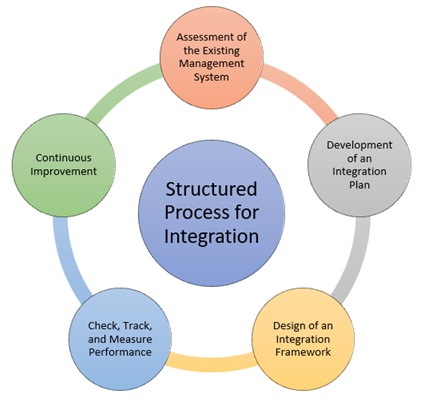
Integrating Process Safety Management with Health, Safety, and Environment is a strategic transformation, not merely a documentation exercise. It requires engineering competence, regulatory understanding, and practical operational insight.
We, EHS Management Consultants, are competent engineers with extensive experience in developing, integrating, and implementing PSM and HSE management systems across high-risk industries. We support organizations in moving from reactive compliance to robust, risk-based, and performance-driven management systems that deliver real business value.
Whether you are establishing a new system or integrating existing frameworks, we are here to help you build a resilient, compliant, and efficient PSM–HSE ecosystem.