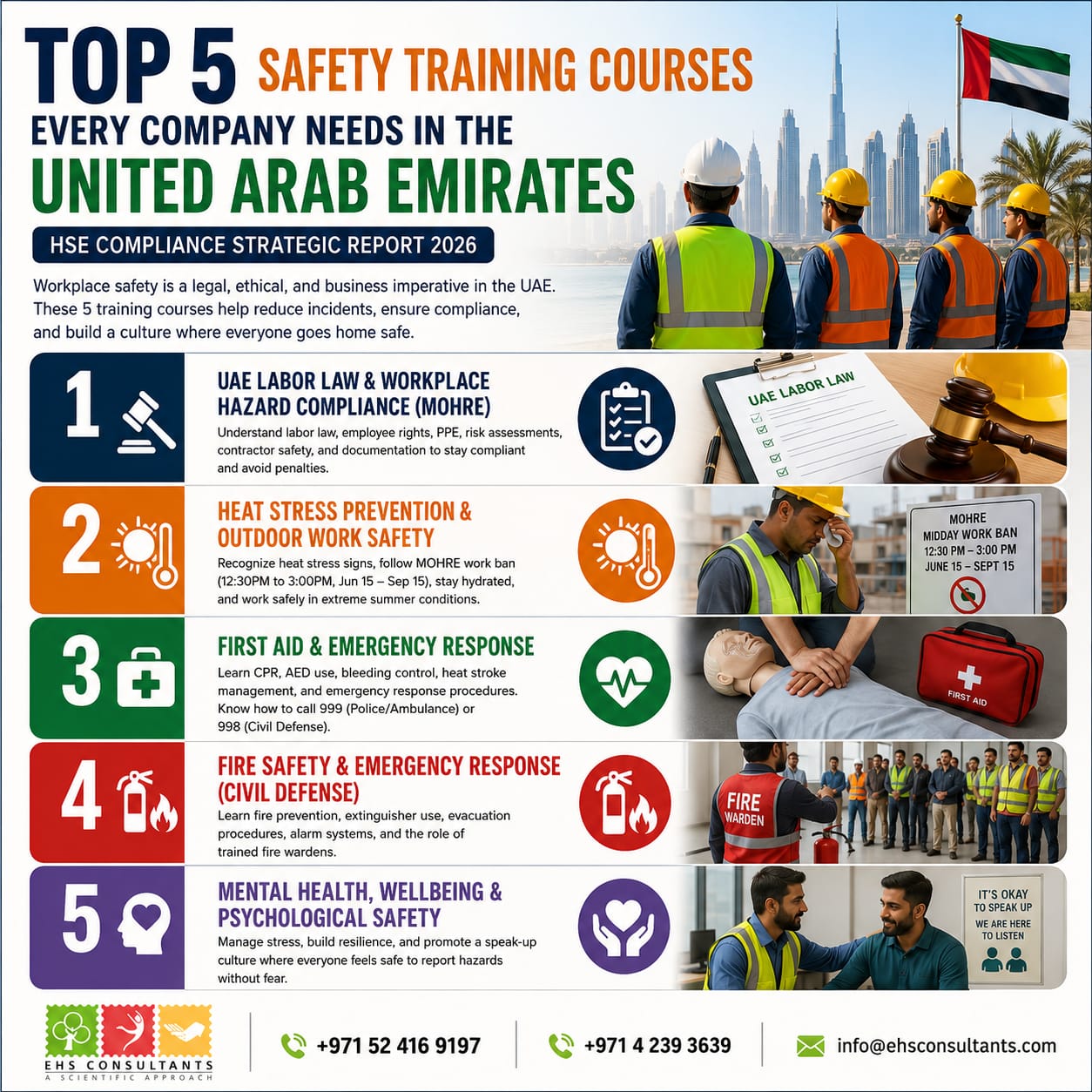
Workplace safety in the UAE is governed by federal labor law, emirate-level authorities, and international best practices. With a workforce of over 9 million employees spanning construction, hospitality, oil and gas, retail, and logistics, safety training is a legal, ethical, and business imperative for every company operating in the country.
The foundation of any UAE safety program is a clear understanding of the Federal Decree-Law No. 33 of 2021 (the UAE Labor Law). The Ministry of Human Resources and Emiratization (MOHRE) oversees enforcement, and companies that fall short face fines, work stoppages, and license complications.
This training ensures every employee understands their rights and responsibilities, knows how to report a hazard or incident through the correct channels, and is familiar with the PPE and risk control requirements relevant to their role. Managers and supervisors need a deeper grounding that includes how to conduct risk assessments, manage contractor safety, and maintain the documentation MOHRE inspectors.
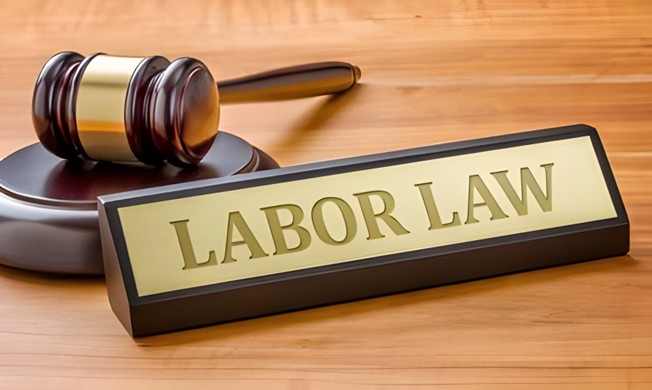
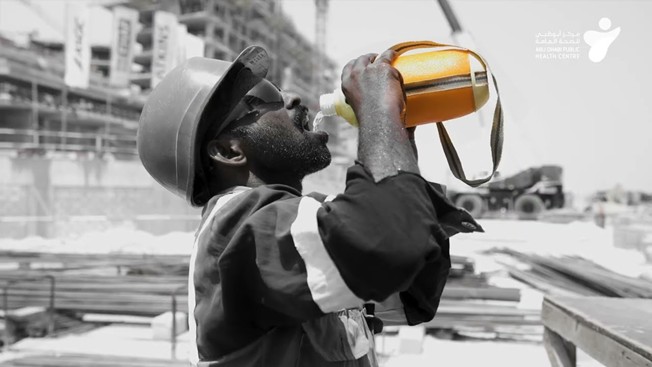
Uniquely critical to the UAE, this is non-negotiable for any company with outdoor operations. Summer temperatures regularly exceed 45–50◦C. MOHRE enforces a midday work ban from 12:30 PM to 3:00 PM between June 15 and September 15.
Heat stress, heat exhaustion, and heat stroke kill workers every year. Construction crews, landscaping teams, logistics drivers, utility workers, and agricultural laborers are at daily risk throughout the summer months. Employers are legally required to provide shaded rest areas, potable water, and cooling stations but trained workers who understand their own physiological warning signs and can recognize heat illness in a colleague are far better protected than those relying on rules alone. This training is especially important for newly arrived workers, who are statistically most vulnerable during their first two weeks before the body acclimatizes to the heat.
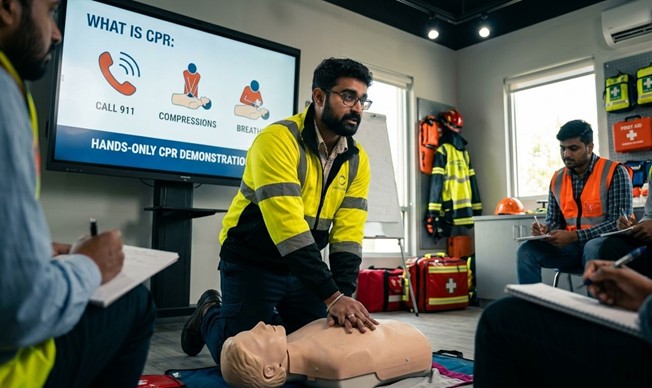
The Dubai Health Authority (DHA) and Abu Dhabi Health Services (SEHA) both recognize first aid certification, and many free zones and industry regulators including those governing construction, hospitality, and manufacturing always require a minimum ratio of certified first aiders to employees on site. Beyond regulatory compliance, the human case is straightforward: a colleague who knows how to control bleeding, manage a heat stroke victim, perform CPR, or operate an AED can save a life that would otherwise be lost.
First aid training in the UAE context must account for the specific emergencies most likely to occur locally heat-related illness, construction trauma, chemical exposure in industrial settings, and the high volume of road traffic accidents involving employees during commutes. Training should also cover how to communicate with UAE emergency services (999 for police and ambulance, 998 for Civil Defense) and how to manage an incident scene until professional help arrives.
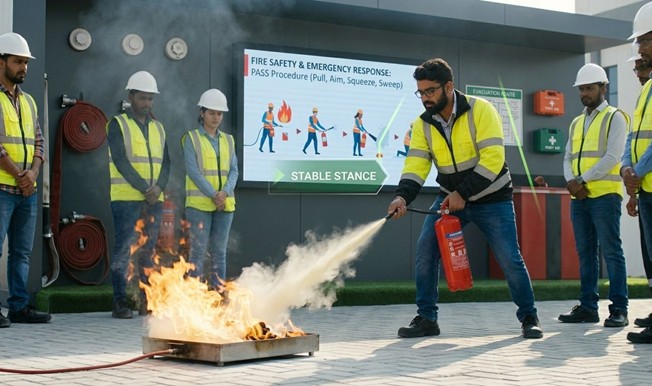
The UAE Fire and Life Safety Code of Practice mandates fire safety training and the appointment of trained fire wardens. Civil Defense conducts regular inspections with strict penalties for non- compliance.
Dubai Civil Defense and Abu Dhabi Civil Defense issue building approvals and conduct regular inspections. Companies that fail face fines, forced closures, and in serious cases, criminal liability for responsible managers. Given the UAE’s built environment soaring high-rises, petrochemical facilities, densely packed industrial zones, and large labor accommodation camps fire safety training must be tailored to the actual work setting. Evacuation from a 40-floor tower requires entirely different procedures than evacuation from a warehouse or a labor camp.
Fire wardens play a particularly important role in the UAE context, where large numbers of workers may be unfamiliar with building layouts, may not speak the primary language of signage, and may panic in an emergency without a calm, trained guide.
This is the most under addressed safety issue in the UAE and one of the most consequential. Over 88% of the UAE’s private sector workforce is expatriate, with the majority separated from families, living in shared accommodations, navigating cultural and language barriers, and working under significant financial pressure. These compounding stressors create serious mental health risks that translate directly into safety incidents.
Fatigue, depression, financial anxiety, and social isolation impair judgment and reaction time. Workers in acute mental distress are significantly more likely to take shortcuts, overlook hazards, and be involved in accidents. The UAE government has recognized this: the Worker Wellbeing Policy, the Ministry of Happiness initiatives, and growing expectations around corporate responsibility all signal that mental health is now firm part of the safety conversation.
Equally important is the concept of psychological safety, the confidence that speaking up about a hazard or concern will not result in punishment or ridicule. In the UAE’s often hierarchical workplace culture, junior workers, especially migrant laborers, can feel strong social pressure not to challenge supervisors or question unsafe practices. Training that explicitly builds speak-up culture, and leaders who visibly model it, can be the difference between a near-miss that gets reported and one that becomes a fatality.

The UAE is one of the most dynamic and diverse work environments in the world. A safety program that works here must account for extreme climate, a multilingual workforce, and a fast-moving regulatory landscape. These five courses don’t just reduce incidents they build a culture where people look out for one another and go home safe every shift.
CONTACT EHS CONSULTANTS