DCAS Approved First Aid Training / Basic First Aid

DCAS Approved Training

Emergency First Aid Training in Dubai

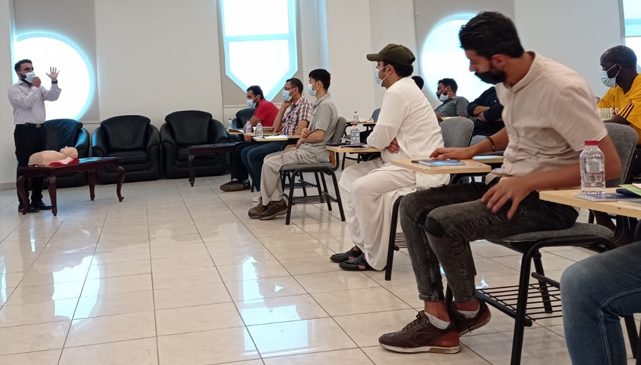
Emergency First Aid Training is a practical and comprehensive 1-day certification program designed to equip employees with the knowledge and skills required to respond quickly and safely to workplace injuries and medical emergencies.

The course covers essential first aid procedures including incident assessment, CPR, AED use, treatment of bleeding, burns, fractures, choking, shock, seizures, and other medical conditions. This training helps participants understand their responsibilities as first aiders, follow proper emergency procedures, and provide immediate care until professional medical assistance arrives.
Duration1 Day
QualificationEmergency First Aid Certificate
Emergency First Aid Training
Course Overview

Prepare your team to respond when it matters most

The scope of this training program is designed to applies to all personnel who require or to provide first aid treatment in the event of an injury.

The program is suitable for all employees as part of workplace safety requirements and induction training, ensuring a safer working environment through preparedness, prevention, and effective emergency response.

Target Audience

Who should attend?

Intended for all employees who may be called upon to render first aid, or as part of induction training.

Training Curriculum

What the course covers

Practical modules covering essential first aid knowledge and workplace emergency response.

01

Module 1: Introduction to First Aid

  • Definition, aim and it’s importance
  • Responsibilities of first aider
  • Emergency Services
  • Prioritising the treatment
02

Module 2: Assessing an Incident

  • Primary scene survey
  • Secondary Survey
  • The recovery position
  • Casualty communication
03

Module 3: Basic Life Support

  • Principles of resuscitation
  • Rescue breathing
  • Administering CPR
  • Automated External Defibrillator (AED)
04

Module 4: The Respiratory System

  • Obstructed airway
  • Recognising a choking casualty
  • Dealing a choking adult
05

Module 5: The Circulatory System

  • Wounds and bleeding
  • Types of bleeding
  • Treatment of bleeding
06

Module 6: Shock

  • Physiological Shock
  • Anaphylaxis
07

Module 7: Seizure

  • Epileptic seizure
  • Partial seizure
  • Generalized seizure
08

Module 8: Dealing With Minor Injuries

  • Contusions (Bruises)
  • Minor cuts and Grazes
  • Minor burns and scalds
  • Foreign objects
  • Splinters
09

Module 9: Other Injuries and Incidents

  • Fractures and Dislocations
  • Heart Attack
  • Stroke
  • Head Injuries
Frequently Asked Questions

First Aid Training FAQs

Find answers to common questions about First Aid training, practical sessions, certification and DCAS-related workplace requirements.

You will learn how to respond safely and effectively to common workplace and emergency situations. The training generally covers CPR, AED use, recovery position, choking, bleeding, burns, fractures, fainting, seizures, emergency response and other essential First Aid procedures.
First Aid training is suitable for employees, supervisors, safety personnel, teachers, security staff, facility teams, construction workers and anyone who may need to respond to an emergency before professional medical help arrives.
The duration depends on the course level, curriculum and certification requirements. Basic First Aid courses are commonly delivered as a structured one-day or multi-session programme. The exact duration should be confirmed with the training provider.
First Aid training should combine both theory and practical learning. Participants learn the principles behind emergency care and then practice important techniques through demonstrations and practical exercises.
Yes. Practical demonstrations can cover CPR, AED operation, recovery position, choking response, bleeding control, bandaging and other essential First Aid techniques.
Yes. CPR practice is an important part of First Aid training. Participants can practice chest compressions and other CPR steps using training mannequins under instructor supervision.
Where AED training is included in the selected program, participants will learn how an Automated External Defibrillator is used and practice the basic operating procedure with an AED trainer.
Yes. Hands-on practice allows participants to develop confidence in performing CPR rather than only learning the procedure theoretically.
Yes. Participants are taught the appropriate procedure for placing a suitable unconscious but breathing casualty into the recovery position while monitoring their condition.
Yes. The training can cover recognition of choking and appropriate First Aid response for a choking casualty, including the distinction between partial and severe airway obstruction.
Yes. Participants learn how to recognise serious bleeding, apply appropriate pressure and dressings, protect themselves from exposure to blood and manage wounds until further medical assistance is available.
Yes. Participants learn how to recognise different types of burns and the appropriate immediate First Aid response, including when professional medical attention is required.
Yes. The course can explain how to recognise suspected fractures and other injuries, how to avoid unnecessary movement and how to provide appropriate initial support while awaiting medical assistance.
Yes. Training can cover the appropriate First Aid response to fainting and seizures, including protecting the casualty from further injury and understanding when emergency medical assistance is required.
Yes. A qualified trainer should demonstrate the correct CPR technique before participants practise it themselves.
Yes, when AED training is part of the course. Participants learn when an AED may be required, how to follow the device's instructions and how to coordinate AED use with CPR. DCAS guidance specifically addresses AED provision and training, including maintenance and keeping trainees' knowledge updated.
Yes. Participants learn how to assess an emergency, protect themselves and others, raise the alarm, contact emergency services and provide appropriate First Aid until professional assistance arrives.
Yes. Safety assessment is an important first step. Participants are taught to identify hazards and take appropriate precautions before approaching or treating an injured person.
Yes. Workplace scenarios can be incorporated into the training to help participants understand how First Aid principles apply to realistic emergency situations.
Yes. Practical exercises are an important component of effective First Aid training. Participants can practice relevant techniques under trainer supervision.
No. Basic First Aid courses are generally designed for people without previous First Aid experience. Specific advanced courses may have their own prerequisites.
No. Medical experience is not normally required for basic First Aid training. The course is designed to teach participants the skills required to provide appropriate initial assistance within the scope of their training.
Do not worry. Practical sessions are supervised learning environments. The trainer can correct the technique, explain the correct procedure and allow you to practice again safely.
Where practical assessment forms part of the selected certification program, the trainer will assess participants against the required practical skills and procedures.
This depends on the specific First Aid course and certification program. Courses may include written, oral and/or practical assessments.
Participants who successfully complete the required training and assessment requirements can receive a certificate from the relevant training provider or awarding body.
The validity period depends on the certification scheme and awarding body. Participants should check the certificate and the specific requirements of their employer or applicable authority.
Yes. On-site training can be arranged for organisations where the training provider offers workplace delivery. This can also allow scenarios and exercises to be tailored to the workplace environment.
Yes. Training can be adapted to address relevant workplace risks, such as construction hazards, chemical exposure, industrial injuries, burns or other identified emergency situations, subject to the course and certification requirements.
Yes. Group training can be arranged for organizations, subject to suitable facilities, trainer availability, equipment and the requirements of the applicable training program.
Depending on the course, practical training may require CPR mannequins, AED trainers, First Aid kits, bandages, dressings, gloves and other training equipment.
Training providers may provide CPR mannequins and AED trainers as part of the practical session. Confirm the equipment arrangement with the provider before booking.
Participants should normally bring comfortable clothing suitable for practical activities, a notebook or writing materials if required, and any identification or documents requested by the training provider.
Participants should understand how to assess an emergency, respond safely, raise the alarm, provide appropriate basic First Aid, perform CPR where trained, use an AED where included, manage choking and bleeding, and support an injured or ill person until professional medical help arrives.
The requirement depends on the workplace's risk classification and number of people. For low-risk workplaces: Less than 50 persons: 1 EMT or 1 First Responder; 50 or more persons: 2 EMTs. For high-risk workplaces, such as large construction sites, chemical plants and factories, the manual specifies 1 AEMT per shift, or 2 AEMTs where there is no shift system.
The appropriate qualification depends on the workplace risk level and role. DCAS defines an EMT as a professional who has successfully completed First Aid training and obtained a certificate of competence from an accredited institution. A First Responder is similarly required to complete First Aid training and hold a recognized First Response certificate.
Yes. DCAS's workplace manual specifies requirements concerning First Aid kits, equipment, protective equipment, stretchers and other workplace First Aid provisions. Kit contents should reflect the workplace's needs, including the number of employees, premises, activities and available medical personnel.
Yes. DCAS's manual requires First Aid rooms to be clearly identified with a sign. It also requires an “In Case of Injury at the Workplace” poster at the First Aid station.
Yes. DCAS has statutory authority relating to the authorization and regulation of basic and advanced First Aid training centers in Dubai.
For establishments providing regulated basic or advanced First Aid training services in Dubai, DCAS authorization requirements apply. Dubai legislation specifically gives DCAS authority to authorize basic and advanced First Aid training centers.
Where a training establishment is operating under the DCAS-regulated ambulance service framework, its training curricula are subject to DCAS approval. The applicable legislation requires establishments to submit training curricula used for their courses to DCAS for approval.
Certificates issued under an appropriately authorized and recognized training program can serve as evidence of successful training. However, acceptance for a particular workplace role should be confirmed against the current DCAS requirements and the employer's requirements.
Not necessarily. Where the training falls within DCAS-regulated First Aid training services, the provider must meet the applicable authorization and regulatory requirements. DCAS has authority over basic and advanced First Aid training centers.
First Aid training focuses on essential immediate care and emergency response skills such as CPR, AED, choking, bleeding, burns and basic casualty management. Advanced First Aid training is intended for personnel with broader emergency-care responsibilities and may include more advanced interventions and competencies. The exact content depends on the certification and regulatory framework. DCAS distinguishes between basic and advanced First Aid services and defines AEMTs in connection with advanced cardiovascular or pediatric life-support training.
Emergency First Aid generally focuses on immediate response to an emergency, including lifesaving actions such as CPR, AED use and management of choking or serious bleeding. Workplace First Aid applies these principles specifically to occupational environments and considers workplace hazards, emergency procedures, First Aid equipment, trained personnel and site-specific risks. In Dubai, the DCAS workplace First Aid manual applies to public and private workplaces, including construction sites.
Assessment requirements depend on the particular certification program. Where assessment is specified, participants must successfully complete the required assessment to receive certification.
Not necessarily for every First Aid course. Assessment methods depend on the particular course, awarding body and certification requirements. A program may include theoretical and practical assessment where required.
Renewal should follow the requirements of the certification scheme, employer and applicable regulatory requirements. Regular refresher training is also useful because practical emergency skills can decline without practice.
Certificate validity depends on the issuing organisation, certification program and applicable requirements. The expiry or renewal date should be checked on the certificate and with the training provider.

Build a safer, more prepared workplace

Equip your team with practical first aid knowledge and emergency response skills.

Enquire About Training
Learning Outcomes

Course Objectives

Participants develop the confidence and practical awareness needed to respond appropriately during emergencies.

  • To outline the training and certification requirements for first aiders
  • To ensure that the required first aid stations are provided and maintained at your workplace
  • To follow appropriate emergency procedures and provide interim first aid
  • Teach participants how to respond quickly to medical emergencies
  • Encourage proactive measures to prevent accidents and injuries in various environments